• Home
  • Applications
  • Technology
  • About us
  • News and Insights
  • Contact us
Site Logo
05 Jun 2026
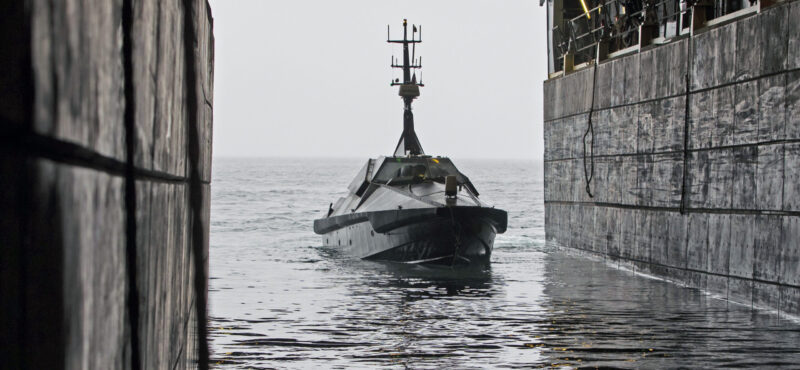
Image of the MAST-13 Autonomous Surface Vehicle, entering the loading dock of HMS Albion.

HMS Albion hosted Exercise Autonomous Advance Force in March 2020 to show case the abilities of the unmanned projects. 

47 Commando worked alongside HMS Albion and NavyX to trial unmanned technology in Norway. Exercise Autonomous Advanced Force looked at how the Royal Navy and Royal Marines could benefit from the latest technology and enhance future operations.

It put unmanned boat Mast 13, drone Malloy and remote-piloted aerial system Puma through their paces in harsh Arctic conditions and in an operational theatre alongside Albion.

It is the latest in a series of trials as part of the Royal Navy’s commitment to technology and innovation and the Future Commando Force concept.
First Bearings

Voyant CEO James Norwood reflects on his first 30 days — the technology, the team, and what leading a deep-tech defence company demands of a leader.
  • Comments: 0
  • Posted by: James Norwood
Read more
Categories
Liverpool

UNIVERSITY OF LIVERPOOL’S FOUND...

Uncategorized

Voyant has welcomed the announcement that the university has become a founding member of the UK's new Defen...

0a7b0c16-a7ca-4595-b07e-100bc9f6b0dd

Meet the Voyant team: Dr Chris Blackman

Team

Chris has joined Voyant as a Senior Engineer, specialising in ML, statistics, and advanced radar signal pro...

Kraken-Autonomous-Boats-for-UK-Navy

High-Precision Navigation System for ...

Case study

Voyant, a leading tracking and data fusion company, today announced the development of a highly accurate na...

1

Voyant appoints new CEO

News

James' appointment strengthens the company’s strategic leadership as it accelerates the delivery of next-ge...

Image of the Mojave unmanned aerial vehicle (UAV), seen here landing on the flight deck of HMS Prince of Wales.

On 15th November 2023, Codenamed “Mojave”, the specially modified remotely piloted aircraft successfully launched from, and then safely landed back onto, the deck of HMS PRINCE OF WALES in a unique trial off the East Coast of the United States of America. A European first, this trial further unlocks the potential of the UK’s Queen Elizabeth-Class aircraft carriers – designed and principally built around the F-35B Lightning stealth fighter – by demonstrating how modern uncrewed air systems can operate alongside 5th generation crewed aircraft.

After months of planning, successful trials of the largest uncrewed aircraft to ever launch from an aircraft carrier outside of the United States have paved the way for the next generation of air power to be delivered from the Royal Navy’s two supercarriers.

The Mojave trial marks the end of a successful series of experiments and tests with uncrewed aircraft to and from our aircraft carriers this autumn, and follows on from the successful demonstration in September when a small W Autonomous Systems logistics supply aircraft delivered supplies to HMS PRINCE OF WALES in the English Channel.  

The Mojave is an adaptation of the MQ1C Grey Eagle aircraft that has been developed for short take-off and landing (STOL), originally to prove STOL operations were capable at unprepared landing sits. With a 17m wingspan, the UAS is 6m wider than an F-35B Lightning steal fighter, and weighs 1.5 tonnes in its fully loaded configuration. The medium altitude, long endurance, remotely piloted aircraft can provided long-range surveillance and strike capability over areas covering many thousands of miles.

Modular counter-UAS solution launched

Case study

Voyant announced the development of its advanced counter-uncrewed Aerial Systems (C-UAS) solution, designed...


Copyright © 2026 Voyant