Voyant achieves Cyber Essentials Plus certification Voyant has achieved Cyber Essentials Plus certification, reinforcing its commitment to protecting the systems and information that support its work. Cyber Essentials Plus includes an independent technical assessment of an organisation’s cyber security controls, checking that measures are in place and working to protect against common cyber threats. For...
Voyant has successfully completed the European Space Agency’s Business Incubation Centre UK programme at Harwell. Through the programme, we explored how our Track Before Detect (TkBD) technology could support electronic warfare (EW).
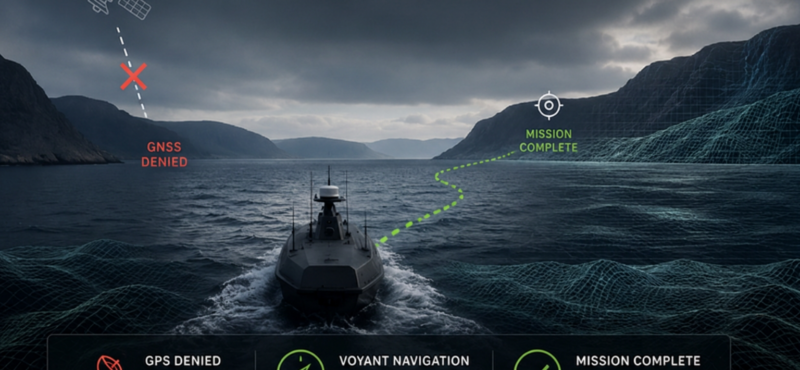
Voyant has successfully demonstrated its advanced navigation software to the UK Ministry of Defence (MOD), marking an Important step in the development of resilient Position, Navigation and Timing (PNT) capabilities for autonomous maritime systems operating in contested environments.
Voyant has successfully demonstrated how advanced software can unlock significantly greater capability from existing sonar systems as part of a UK Ministry of Defence's Programme to strengthen anti-submarine warfare operations.
The UK has world-class defence research. But innovation only creates advantage when it moves from the laboratory into operational use. James Norwood explores why stronger connections between academia, industry and the front line will be critical to maintaining the UK’s innovation edge.
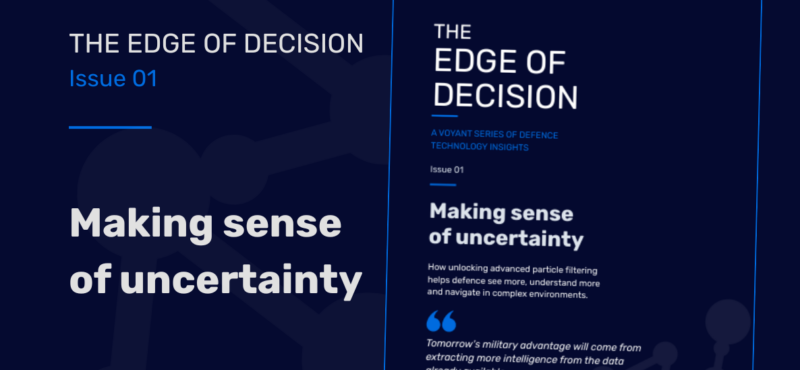
As defence environments become more complex and uncertain, conventional tracking approaches can struggle to preserve the information operators need. The first issue of The Edge of Decision explores how advanced particle filtering can deliver greater tracking confidence within real-world platform constraints.
'Particle filters instead use many individual hypotheses, or “particles”, to represent the probability distribution. You can think of them as a crowd of tiny detectives, each backing a slightly different theory about what is going on.'
While primes will continue to provide the scale and stability required for major programmes, with SMEs continuing to drive innovation and technological advantage, I fully expect new collaborative models will continue to emerge.