
- October 20, 2026
- Comments: 0
- Posted by: Amanda Fallbrown
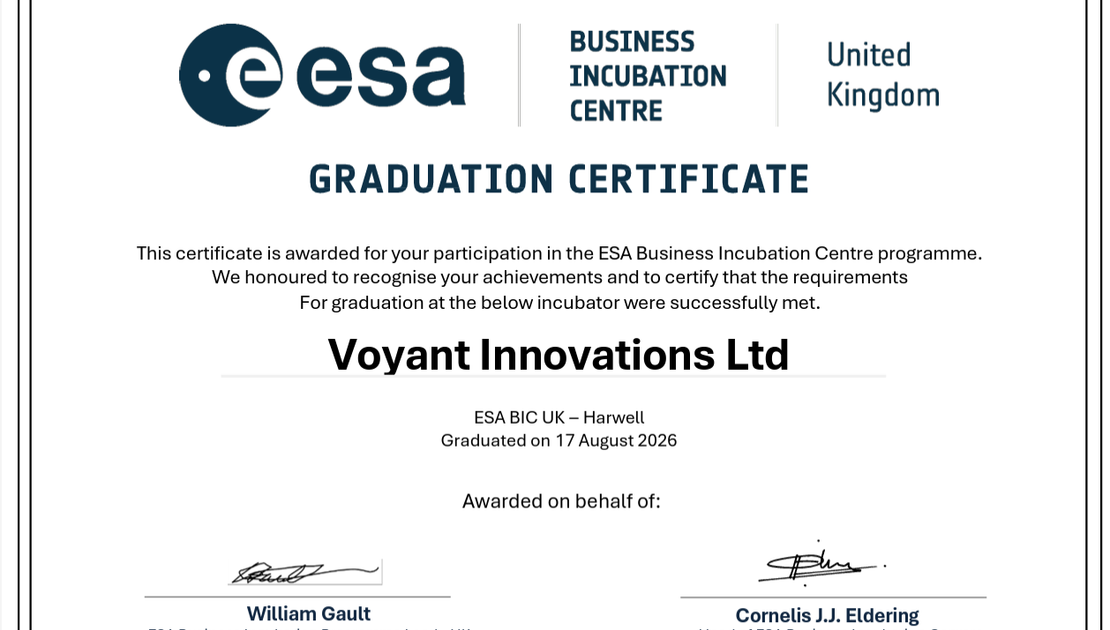
Voyant graduates from ESA BIC UK
Programme confirms clear market opportunity for Voyant’s Track Before Detect technology in Electronic Warfare
Voyant has successfully completed the European Space Agency Business Incubation Centre (ESA BIC) UK programme at Harwell.
The project focused on applying Voyant’s Track Before Detect (TkBD) technology to Electronic Warfare (EW). TkBD builds on capabilities first developed at the University of Liverpool to detect weak targets in highly cluttered environments. The project explored how these advanced probabilistic signal-processing techniques could address one of the toughest problems in modern EW: detecting, separating and classifying emitters in increasingly congested and contested electromagnetic environments.
Getting more from existing sensors
The study assessed how TkBD could improve emitter tracking, pulse deinterleaving and threat identification. It also looked at how the technology could raise the performance of existing sensing infrastructure without costly hardware upgrades.
From technology to market
Alongside the technical work, the project examined:
- Customer requirements
- Operational use cases
- Routes to market
- Opportunities to integrate with current and future defence architectures
The technical assessment, stakeholder engagement and market analysis together pointed to a clear opportunity for TkBD in the fast-growing EW market. Defence customers increasingly want software-based solutions that get more from the sensors they already have. Voyant’s ability to pull weak signals out of complex environments fits that demand closely.
James Norwood, CEO at Voyant, said: “Completing the ESA BIC UK programme is an important milestone for Voyant. It has helped us explore how our advanced tracking technology can tackle one of the biggest challenges in electronic warfare, building on our research heritage and defence experience.
We’re grateful to the team at Harwell for their support, and we look forward to building on the relationships and knowledge we’ve gained through the programme.”