Dr Chris Blackman
Senior Engineer
Joined Voyant: April 2026
Expertise: ML, statistics, and advanced radar signal processing.
‘Compared to simulation, real data is messy. By collecting real data and getting properly stuck into it, features emerge that you wouldn’t have ever considered, forcing you to unpick your assumptions about how you thought the world works.’
What is your background (and what led you to pursue a PhD)
I finished my Masters’ degree in Physics in 2018, then got a job as a software engineer for an aerospace and defence consultancy, but never quite put my academic interests to bed. As the buzz around ML permeated the sector, I found a PhD opportunity at University of Liverpool allowing me to develop my ML and statistics, while working at the cutting-edge of radar signal processing for industrial applications.
If you had 30 seconds to explain your research to a non-technical audience, what would you say?
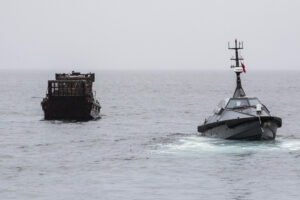
Radar works really well to find objects in where cameras struggle (i.e., in the dark, in the rain, through clouds). However, when you use a radar to find boats on the water- the sea-surface confuses the radar quite badly and is the subject of a great amount of research. Solving this non-trivial challenge would be hugely beneficial for maritime monitoring and surveillance, which is used for marine conservation, security, and water-way management.
My PhD research was around developing novel methods for object detection with a maritime radar, using advanced machine learning methods to handle the challenges around maritime-specific radar confusion.
What interests you most about applying advanced algorithms to real-world challenges?
Compared to simulation, real data is messy. By collecting real data and getting properly stuck into it, features emerge that you wouldn’t have ever considered – and it forces you to unpick your assumptions about how you thought the world works. Then trying to get a computer to understand the complex information in a meaningful way – frankly, just makes for a fun challenge!
What attracted you to Voyant – what do you think makes its technology unique?
For me, it’s the people. Voyant’s team is made up of a group of people who, despite a range of impressive qualifications and backgrounds, are all willing to listen to the least qualified person in the room as if they’re the most. From that, you get technologies which are tested from all perspectives and built on robust designs and strong ideas.
What opportunities do you see for advanced tracking and data fusion in the future?
Advanced tracking algorithms have applications across almost any sector that may benefit from autonomous systems including aerospace and automotive, agriculture, conservation, transport, and logistics – or something as trivial as autonomous vacuum cleaners). Computationally heavy “AI” workflows are everywhere at the minute, and organisations are facing growing costs associated with processing and managing these large amounts of data. There are opportunities for data fusion to address this challenge by extracting more information from a fixed amount of data, improving efficiency, and enabling better decisions without simply increasing data volumes.
What do you enjoy outside of work?
I’m keen on woodworking and building things in my spare time (well, taking things apart is fun – maybe someone else can put them back together!). If it’s not too rainy, I play tennis locally. Being based in the North West of England, rain is never too far away, so instead there are plenty of hikes around massive green spaces and hill walks to enjoy.
Current Focus
Development of resilient navigation technologies that help autonomous maritime vessels operate with confidence in GNSS-denied environments – where satellite navigation signals are frequently degraded, disrupted or unavailable.